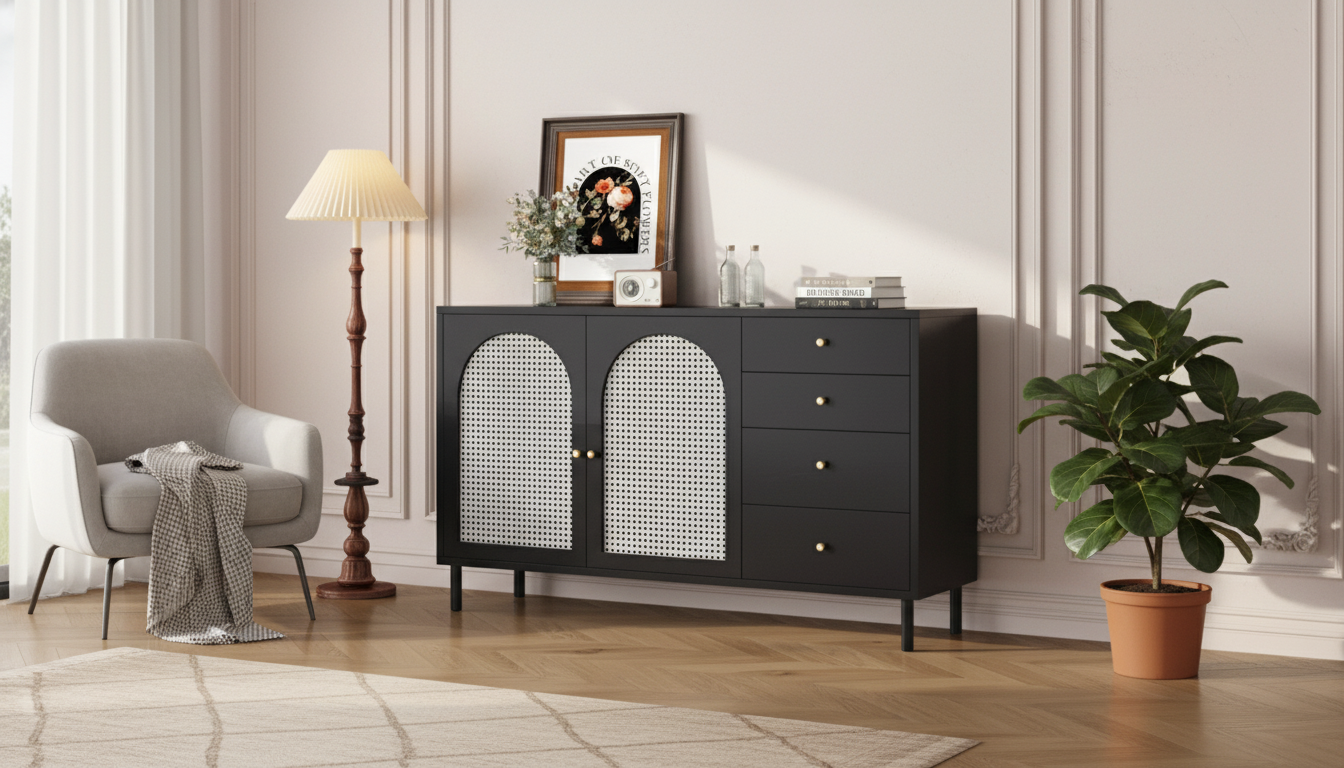
A modern minimalist sideboard keeps a room visually calm while adding serious storage. With a streamlined silhouette and a deep black finish, this style works as a dining buffet, a living-room media console alternative, or a sleek entry catch-all—without competing with art, lighting, or architectural lines. The payoff is simple: fewer items left out, cleaner surfaces, and a stronger “done” feeling even in busy, everyday homes.
Minimalist sideboards look effortless, but the best ones are carefully edited in both form and function. A few design cues create that clean, modern presence while still doing the hard work of storage.
If you’re looking for a single piece that can move between rooms as your needs change, the Modern Black Minimalist Sideboard offers a strong, clean profile that reads modern without feeling cold. Black is a natural “frame” color: it sharpens the edges of a space, looks intentional against light walls, and pairs easily with warm wood floors and mixed metals.
| Room | Best use | Top styling | What to store inside |
|---|---|---|---|
| Dining room | Buffet + serving station | Large mirror or art centered above | Plates, serving bowls, linens |
| Living room | Low storage wall anchor | Table lamp + stack of books | Games, throws, cables, media accessories |
| Entryway | Drop zone with hidden clutter | Catch-all tray + small vase | Hats, bags, keys, seasonal items |
| Home office | Clean filing + equipment storage | Neutral object + plant | Paper, peripherals, printers, supplies |
Minimalism looks best when the scale is right. Too small and a sideboard feels like an afterthought; too large and it can make the room feel compressed. Use these practical guidelines to keep the layout comfortable and visually balanced.
Black furniture can look crisp for years with the right finish and a few smart habits. The biggest difference is how the surface handles touch points (hands near doors and drawers) and how it responds to light in your home.
For households that prioritize healthier interiors, it can also help to stay informed about indoor air quality and common pollutants. The U.S. Environmental Protection Agency’s overview of indoor air quality is a solid starting point: https://www.epa.gov/indoor-air-quality-iaq. If wood sourcing matters for your values, the Forest Stewardship Council explains responsible forestry and certification here: https://fsc.org/en.
These terms overlap: “sideboard” and “buffet” are most commonly used in dining rooms for serving and storage, while “credenza” is often used in living rooms or offices. Differences are mostly convention and intended use rather than strict rules.
Matte or satin finishes help hide smudges, and a quick microfiber wipe keeps streaking down. Low-profile or push-to-open fronts reduce high-touch zones, and a small tray on top prevents scattered items from constantly being moved around.
Center the mirror or artwork over the sideboard and leave a comfortable gap above the top so it doesn’t feel crowded. Keep the surface minimal—use one taller anchor piece (like a lamp) and avoid lining up lots of small decor across the entire length.








Leave a comment